
This review evaluates DentaVive on the information that can actually be verified: the ingredients and claims published on the manufacturer's product pages, and the state of published research on the strains named there. It does not report first-hand use. We have not tested DentaVive, and any page claiming a personal before-and-after result for a product like this deserves scepticism unless it shows its evidence.
Read alongside our ingredient-by-ingredient analysis and explanation of the proposed mechanism.
What is DentaVive?
DentaVive is a dietary supplement marketed for oral health. It is sold in a chewable form and built around a blend of probiotic bacterial strains, with tricalcium phosphate and the prebiotic fiber inulin also listed. It is sold direct-to-consumer online rather than through pharmacies or dental practices, and a "v2" designation appears in some listings, which buyers use to distinguish a revised presentation of the product from earlier ones.
In regulatory terms it is a supplement, not a medicine. That distinction matters: dietary supplements in the United States are not evaluated by the FDA for effectiveness before sale, and they are not approved to diagnose, treat, cure or prevent any disease.
What does DentaVive claim to do?
The manufacturer's materials frame the product around supporting the health of teeth and gums, supporting a balanced population of bacteria in the mouth, and contributing to fresher breath. The underlying idea presented is that the mouth hosts a bacterial community, that the balance of that community relates to oral health, and that supplying particular strains may support a more favourable balance.
That framing is coherent with how oral microbiology is discussed in the scientific literature. What the marketing then does — and this is where care is needed — is move from a plausible mechanism to an implied outcome. A claim that a strain influences bacterial populations is a narrower statement than a claim that a finished product improves gum health. We treat any manufacturer statement as a claim, not a finding.
How the formula is presented
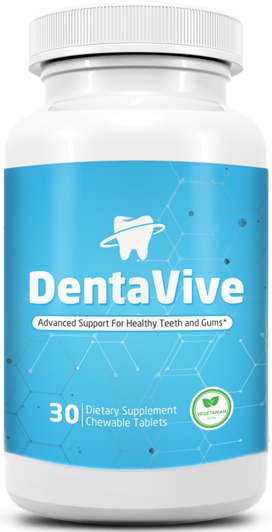
Ingredient names are disclosed, which is better than the proprietary-blend opacity common in this category. What is not clearly published is the colony-forming unit (CFU) count per strain. That is a meaningful gap: in probiotic research, effects are dose- and strain-specific, and without a CFU figure there is no way to compare the product to the doses used in the studies that make the concept plausible in the first place.
Ingredients and formula
The strains and other ingredients named in the product information are:
- Streptococcus salivarius K12 — a strain studied mainly in relation to oral bacterial populations and breath compounds.
- Lactobacillus reuteri — studied in several small trials on gingival and plaque measures.
- Lactobacillus salivarius — a species found natively in saliva, studied for interactions with oral bacteria.
- Lactobacillus paracasei — widely used in food and supplement probiotics; oral-specific evidence is thinner.
- Bifidobacterium lactis BL-04 — a well-characterised strain studied mostly outside the oral cavity.
- Tricalcium phosphate — a calcium and phosphate source, also used as a manufacturing aid.
- Inulin — a prebiotic fiber included as a substrate for bacteria.
Our ingredients page takes each of these separately and states, for each one, what the research has investigated and what it does not establish.
What the available evidence says
We found no published clinical trial of the finished DentaVive formula. That is not unusual for a direct-to-consumer supplement, but it is the central fact of this review. Everything supportive that can be said about the product is said about its ingredients in other contexts, at doses we cannot confirm are matched here.
The ingredient-level literature is real but modest. Oral probiotic trials tend to be small, short, heterogeneous in design, and frequently industry-funded. Systematic reviews in this area generally conclude that some strains show promise for specific narrow outcomes — plaque indices, gingival inflammation scores, volatile sulphur compounds associated with halitosis — while noting that the evidence base is not strong enough for firm clinical recommendations.
How to read a probiotic claim
Effects in probiotic research belong to specific strains at specific doses. "Lactobacillus has been shown to…" is not a meaningful sentence; the strain designation and the CFU count are the parts that carry the evidence.
Potential advantages
- The formula is built on strains that appear in genuine oral-microbiome research, rather than on generic botanical filler.
- Ingredient names are published rather than hidden behind a blend name.
- A chewable format keeps the ingredients in contact with the mouth, which is consistent with the stated intent.
- As a supplement taken alongside normal hygiene, it does not require changing anything that is already working.
Important limitations
- No published trial of the finished product.
- No clearly disclosed CFU count per strain.
- Sales-page testimonials are manufacturer-published. We do not treat them as independent evidence, and neither should you.
- Marketing language around teeth and gums can read as though clinical outcomes are established. They are not.
- Third-party testing and manufacturing certifications are not something we have independently verified.
Who may want to learn more
Adults with a stable dental routine — brushing twice daily, cleaning between teeth, regular check-ups — who are curious about oral probiotics as an optional addition, and who can hold realistic expectations about what a supplement does.
Who should speak with a healthcare professional first
Anyone who is pregnant or breastfeeding, immunocompromised or on immunosuppressive therapy, living with a chronic health condition, taking prescription medication, or recovering from surgery — including dental surgery — should discuss any new supplement with a qualified professional. Children should not be given supplements without paediatric or dental guidance. And anyone with active symptoms — bleeding, pain, swelling, looseness, persistent bad taste — needs a dental examination first.
DentaVive price and purchasing information
DentaVive is sold online through its own offer pages rather than in retail stores. Multi-bottle packages are the standard structure in this category, with the per-unit price falling as the quantity rises, and refund terms stated on the checkout page.
Two practical points. First, buy from the official offer page rather than a marketplace reseller — for a probiotic in particular, storage and handling between the manufacturer and you affect whether the organisms are still viable. Second, read the refund window and the subscription terms before purchasing; the seller's page, not a review site, is the authoritative source for both.
Final assessment
DentaVive is a competently assembled oral probiotic with a strain list that lines up with the field it borrows from. It is not backed by clinical evidence on the finished product, its dosing is not transparent, and the outcomes suggested by its marketing go further than the science currently supports.
If you approach it as an optional, low-stakes addition to good oral hygiene, the proposition is reasonable on its own terms. If you are hoping it will resolve a dental problem, reverse gum disease or replace treatment, it will not, and the time spent waiting has a real cost. That is the honest shape of the answer.
Frequently asked questions
Are DentaVive reviews trustworthy?
Most pages ranking for this term are affiliate content, including this one — the difference is whether the analysis is separable from the commission. Look for pages that distinguish claims from evidence, disclose the affiliate relationship, and avoid inventing personal test results.
Is DentaVive FDA approved?
No. The FDA does not approve dietary supplements for effectiveness. Manufacturers are responsible for safety and labelling, and products may be made in facilities registered with the FDA — which is a statement about the facility, not an endorsement of the product.
How long would someone need to take it?
Probiotic trials typically run four to twelve weeks. Colonisation of the mouth by supplemented strains is generally transient, meaning any effect tends to depend on continued use. The manufacturer's own directions should be followed.
Does DentaVive have side effects?
Probiotics are generally well tolerated in healthy adults, with mild digestive upset the most commonly reported effect in the literature. Risk is higher for immunocompromised or seriously ill people. Check the full label for allergens and stop use and seek advice if you react to it.
References
- 1NIH Office of Dietary Supplements — Probiotics: Fact Sheet for Health Professionals
- 2NIDCR (National Institute of Dental and Craniofacial Research) — Periodontal (Gum) Disease
- 3PubMed — Probiotics and oral health: search of the peer-reviewed literature
- 4FDA — Dietary Supplements: what they are and how they are regulated
Continue reading
- DentaVive ingredients analysisEach strain and ingredient, what it has been studied for, and what that research does not establish.
- How DentaVive is said to workThe oral microbiome explained plainly, with product claims kept separate from research findings.
- Pros and considerationsA balanced summary of the arguments for and against, without manufactured negatives.
- DentaVive FAQShort, direct answers to the questions people actually search for.